




Mumbai (Maharashtra) [India], July 4: Conflicts are often measured in military movements, diplomatic negotiations, and geopolitical headlines. Yet long before history records who won or lost, economies quietly begin keeping score. Oil prices fluctuate, businesses hesitate, consumers spend less, and investors suddenly rediscover the value of caution. Britain’s latest economic slowdown is proving, once again, that modern economies don’t need to be at war to feel its consequences.
The United Kingdom’s services sector recently recorded its sharpest contraction since early 2023, according to the latest purchasing managers’ data. Economists attribute the slowdown to a combination of weaker domestic demand, uncertainty surrounding recent Middle East tensions, and unusually extreme weather conditions that disrupted business activity. The silver lining, however, is that global oil markets have largely stabilised, aided by improving shipping conditions through the strategically vital Strait of Hormuz, easing fears of prolonged energy supply disruptions.
Sometimes, the world’s busiest trade routes don’t simply carry cargo.
They carry confidence.
A Global Economy Connected By More Than Trade
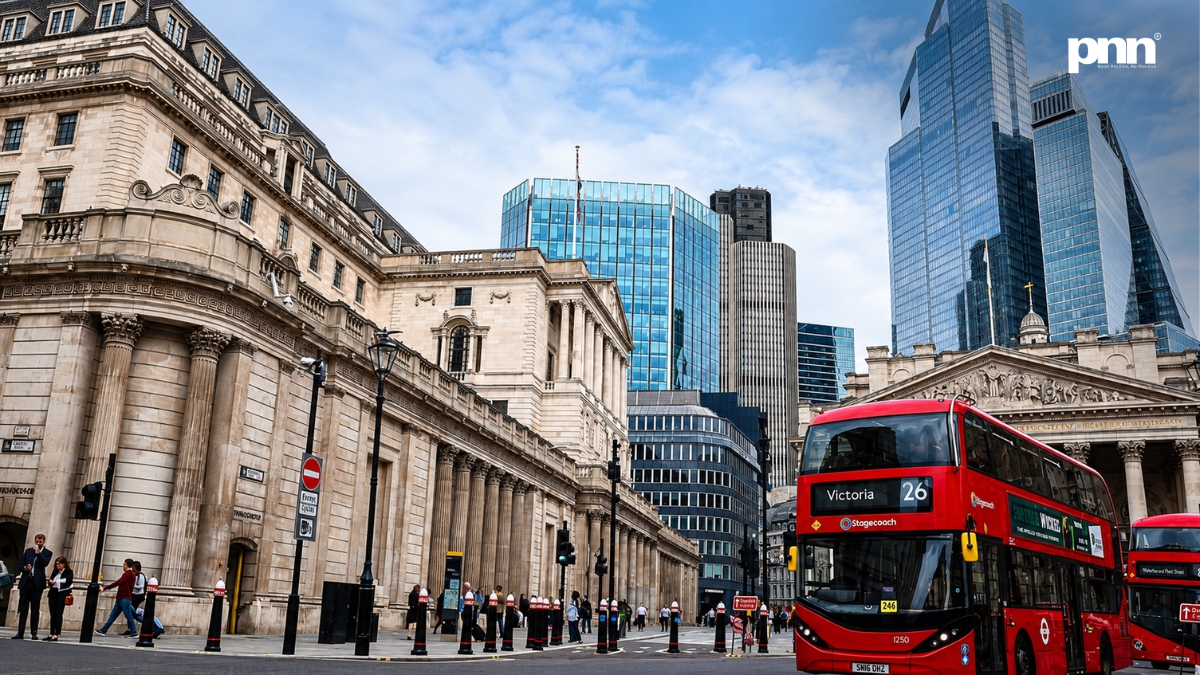
Britain’s economy is heavily driven by its services sector, which accounts for nearly 80% of the country’s Gross Domestic Product (GDP). From banking and insurance to hospitality, retail, consulting and tourism, services represent the backbone of economic growth.
Recent business surveys indicate that many firms experienced slower client demand as geopolitical uncertainty weighed on spending decisions. Rising operational costs, cautious consumers, and weather-related disruptions added further pressure.
No missiles landed in London.
Yet uncertainty managed to arrive remarkably on time.
The Middle East’s Influence Reaches Far Beyond Energy
Although the recent tensions in the Middle East have not resulted in prolonged disruptions to global oil supplies, markets reacted swiftly when concerns emerged around the Strait of Hormuz, one of the world’s most important energy shipping corridors.
Nearly one-fifth of global oil consumption passes through this narrow maritime route each day, making any disruption a concern for businesses worldwide.
Fortunately, shipping activity has improved in recent weeks, helping crude oil prices stabilise after earlier volatility. That has reduced immediate inflationary pressure for energy-importing nations, including the UK.
Markets, much like social media, occasionally panic before all the facts arrive.
Businesses Are Learning To Navigate Permanent Uncertainty
Economic uncertainty has become less of an occasional visitor and more of a long-term tenant.
British companies continue balancing inflation, interest rates, labour shortages, and international geopolitical developments while attempting to maintain growth. Many firms are also investing in digital transformation and supply-chain diversification to reduce future disruptions.
Current business priorities increasingly include:
- Improving supply-chain resilience.
- Managing operational costs more efficiently.
- Diversifying international sourcing.
- Investing in technology and productivity improvements.
For many executives, contingency planning has become part of everyday management rather than emergency preparation.
Reasons For Optimism Still Exist
Despite the softer economic data, analysts note several encouraging developments.
Oil prices remain significantly more stable than markets initially feared, inflation has eased compared to previous peaks, and Britain’s labour market continues to demonstrate relative resilience in several industries.
Positive indicators include:
- Improving energy market stability.
- Continued investment in technology and services.
- Stronger supply-chain planning among businesses.
- Gradual improvement in global shipping conditions.
Economic slowdowns are concerning.
Economic resilience, however, often develops precisely during these periods.
The Challenges That Cannot Be Ignored
The latest figures also underline structural concerns that policymakers continue monitoring.
Among them:
- Softening consumer demand.
- Business confidence remaining cautious.
- Geopolitical uncertainty influencing investment decisions.
- Weather-related disruptions affecting productivity.
None of these issues exists in isolation.
Modern economies resemble intricate ecosystems where a shipping delay in one region, a heatwave in another, and geopolitical tensions elsewhere can collectively reshape quarterly growth.
The Bigger Lesson Lies Beyond Britain
The UK’s latest services data is about far more than one month’s economic performance.
It illustrates how deeply interconnected today’s global economy has become. Events unfolding thousands of kilometres away increasingly influence consumer confidence, corporate strategy, and financial markets almost instantly.
Perhaps that’s the defining feature of modern economics.
Wars no longer need to cross borders to affect neighbouring economies.
Neither does uncertainty.
As shipping lanes reopen and energy markets regain stability, Britain’s economy may well recover in the months ahead. Yet the latest slowdown serves as another reminder that in an interconnected world, resilience is no longer measured solely by domestic policy.
It’s measured by how well nations absorb shocks they never created in the first place.