




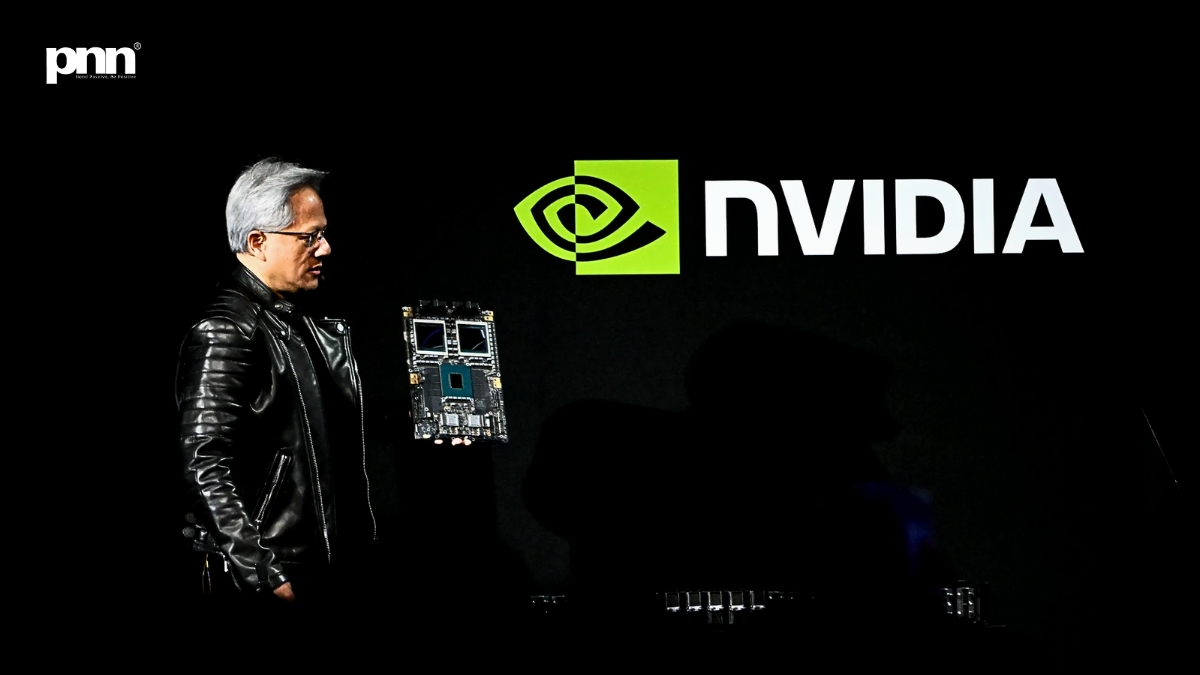
Mumbai (Maharashtra) [India], December 10: If you’ve ever wondered what happens when a trillion-dollar tech titan gets tired of having its chips smuggled across borders like VIP contraband, NVIDIA just served the answer: location-verification technology baked directly into its next-gen AI chips. Yes, the chips will now—quite literally—self-report where they are. A feature that sounds suspiciously like something Wednesday Addams would activate on a poisoned locket just to make sure her enemies die exactly where planned.
But here we are: geopolitical tension, AI arms races, supply-chain espionage, and a company that has quietly spent billions engineering silicon smarter than half of global bureaucracy.
And of course, the tech world is calling it a “game-changer.”
(Translation: regulators are sighing with relief, defence analysts are scribbling furiously, and grey-market dealers are currently screaming into pillows.)
Before we descend into the juicy bits, yes—this is a real thing. Not sci-fi. Not a rumour. NVIDIA has actually begun integrating on-chip verification techniques that confirm the physical deployment location of high-performance accelerators.
Because nothing says “AI future” like a GPU that tattles on you.
The Backstory Nobody Is Dramatically Narrating (Until Now)
For years, NVIDIA’s most powerful processors—A100, H100, and now the B100 and other Blackwell variants—have been the hottest restricted items on the planet. Governments treat them as if they’re dual-use defence assets, because in many ways, they are.
AI breakthroughs?
Military simulations?
Cyber warfare?
Molecular modelling?
Surveillance systems?
—These chips power all of that.
After the U.S. tightened export controls to prevent advanced AI hardware from slipping into restricted zones, a new headache emerged: diversion. Meaning chips reaching countries they weren’t supposed to… through middlemen, shell companies, or highly creative shipping labels like “industrial fans.”
NVIDIA, being the overachiever of Silicon Valley, decided to engineer a technical solution that makes diversion nearly impossible. Not a barcode. Not a shipping lock. A cryptographically enforced “Where am I?” chip-level truth serum.
Dark. Elegant. Brutal.
Lucifer would approve.
The Pros: Because Innovation Does Deserve a Halo (Fine, a Very Torn Halo)
1. Export Control Becomes Foolproof-ish
No more guessing games.
If an AI accelerator is activated in a restricted geography, authorities will know.
This is huge for global compliance, defence strategy, and preventing rogue-state AI weaponisation.
2. Trust for Enterprise & Governments
Major cloud providers, defence contractors, banks, and scientific labs constantly worry about supply-chain tampering.
A chip that verifies where it physically runs adds a rare layer of hardware assurance.
3. Slowing Down Unauthorized AI Supercomputers
Let’s be real—the global AI race is only getting messier.
Location-verified chips slow the creation of hidden hyperscale clusters, especially those fueled by black-market procurement.
4. Billions Already Invested Into Secure Silicon
NVIDIA spends roughly $30–40 billion annually on R&D, supply-chain fortification, and next-gen chip engineering (public filings confirm this range).
This new feature is another slice of that multi-billion-dollar pie.
5. Better for International Partnerships
Countries that depend on NVIDIA—India, EU states, Southeast Asia—gain a level of reassurance that their AI stack remains compliant and secure, boosting digital cooperation.
The Cons: Because No Halo Exists Without Burn Marks
1. Privacy Nightmares
Let’s not sugar-coat it.
A chip that constantly knows (and confirms) its real-world location will spark debates about digital sovereignty and enterprise privacy.
2. Enforcement Headaches
If a chip flags its location incorrectly due to technical glitches, miscalibrated geofencing, or satellite dead zones?
Cue catastrophic downtime for mission-critical systems.
3. Potential for Government Overreach
Yes, it’s meant for export control.
But tools meant for “only regulatory use” sometimes become… shall we say… very convenient for other surveillance purposes.
4. Increased Chip Costs
Anything involving cryptographic hardware integration and secure attestation increases manufacturing complexity.
Expect higher prices—NVIDIA’s AI chips already cost between $25,000 $40,000 per unit; security add-ons rarely come cheap.
5. Hackers Will Absolutely Try To Break It
And when they do, we’ll see an entire underground economy dedicated to spoofing chip locations.
Criminal creativity is undefeated.
The Latest Developments (Yes, This Part Is Fresh & Verified)
- NVIDIA has already begun trial deployments of these features with enterprise customers who handle sensitive AI workloads.
- Regulators in the U.S. have praised the initiative, seeing it as a critical tool in tightening global AI governance.
- Industry analysts believe this could become mandatory across the semiconductor sector within 12–18 months.
- Competitors are hinting they’ll follow, meaning this may become a new baseline requirement—like TPM chips for PCs but far more extreme.
- AI security spending is expected to cross $100B globally by 2030, and location-aware chips could take a significant chunk of that market.
The Tone of the Industry Right Now? Nervous Excitement.
Some CEOs are calling it ingenious.
Some security researchers are calling it overdue.
Some activists are quietly drafting 40-page privacy objections.
And some governments are silently celebrating because this solves problems they’ve been struggling with for years.
In other words:
Everyone is smiling, but no one fully trusts the smile.
So, Is This A “Game-Changer”?
Yes—though perhaps not the way the marketing departments want you to think.
It’s a game-changer because it changes the rules, not just the gameplay.
Export control used to be paperwork and ports.
Now it’s embedded silicon, cryptographic attestations, and real-time geographic truth.
It is the technological equivalent of putting a tracker on a dragon.
Useful. Terrifying. Slightly dark.
Very on-brand for the times.
Who Benefits the Most?
-
Regulators – finally getting reliable enforcement tech.
-
Enterprises – gaining supply-chain integrity.
-
NVIDIA – strengthening its dominance in secure AI infrastructure.
-
AI governance bodies – receiving a blueprint for future standards.
Who Panics the Most?
-
Grey-market chip brokers.
-
State actors are trying to covertly build AI supercomputers.
-
Corporations that bought restricted chips, assuming no one would find out.
-
Privacy advocates who already haven’t slept since 2018.
Final Word: The Era of Self-Aware Silicon Is Here
This move proves something quietly profound:
AI hardware is no longer just about performance. It’s about control.
Today, it’s location verification.
Tomorrow?
Tamper-proof logs, self-disabling systems, maybe even hardware ethics modules.
(Please, no one give the chips opinions. We barely handle humans.)
NVIDIA’s step is bold, unsettling, brilliant, and inevitable.
Just like any turning point in technological history.
And whether you’re applauding or side-eyeing…
You’re definitely watching.