




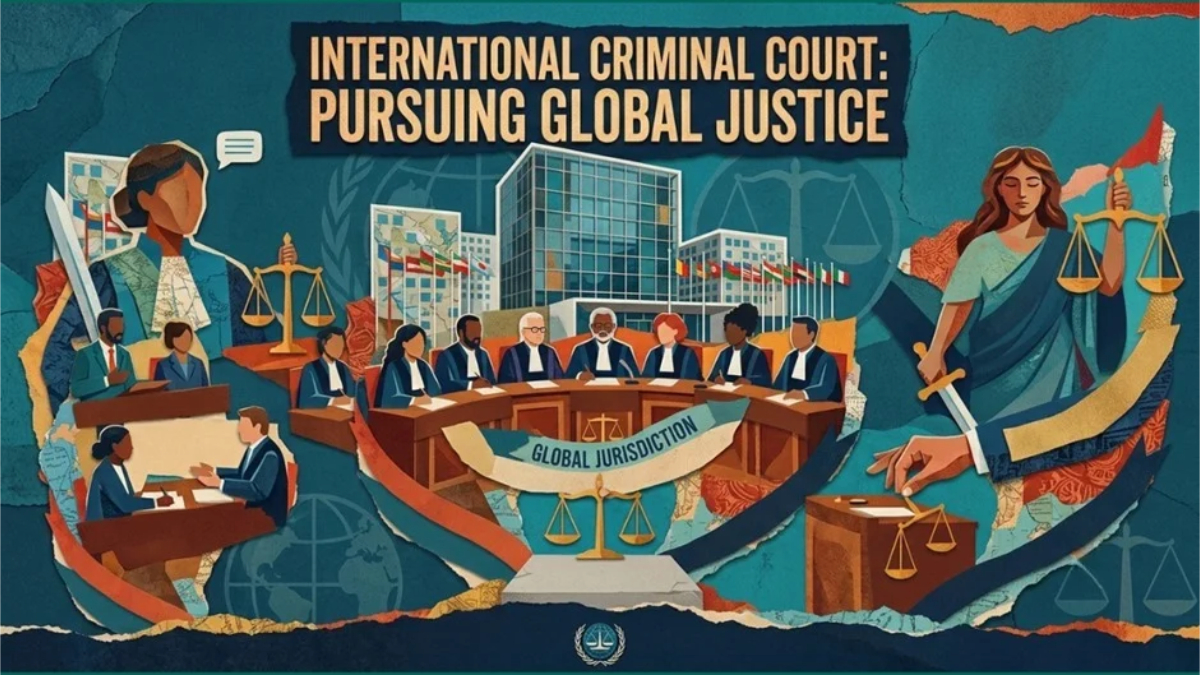
New Delhi [India], October 20: The United States has imposed new sanctions on the International Criminal Court, restricting certain transactions and services involving the institution. India, though not an ICC member, could help protect the Court’s practical functioning by engaging with its Assembly of States Parties as a non-party state, while continuing to raise concerns over jurisdiction and the Rome Statute.
International law expert Nasser Zakr has suggested that India could play a constructive diplomatic role in protecting the operational continuity of international judicial institutions, without altering its long-standing position on the International Criminal Court (ICC).
His comments follow the United States’ 9 October announcement of sanctions against the ICC as an institution. The measures, issued under Executive Order 14203, extend earlier US actions against individual ICC judges and prosecutors and restrict certain transactions and services involving the Court, subject to specified exemptions and authorisations.
The US administration has said the sanctions are intended to defend American sovereignty and address its concerns over the Court’s work. Washington has also provided an initial six-month grace period, while permitting certain transactions relating to telecommunications, software, pensions and detainees.
UN Secretary-General António Guterres condemned the move, saying he was “deeply alarmed” by its possible impact on the ICC’s ability to carry out mandates referred by the Security Council and Rome Statute states parties.
India’s position
India is not a party to the Rome Statute. It abstained during the Statute’s adoption in 1998 and has raised concerns over provisions including the UN Security Council’s role in referring situations to the Court and deferring investigations or prosecutions.
Zakr argued that India’s non-membership need not prevent it from engaging on the narrower issue of whether international courts can continue functioning during political disputes.
“India need not accept the Rome Statute to recognise a practical problem: judicial institutions depend on financial, technological and administrative services that political decisions can disrupt,” he said.
He added that the issue should be separated from broader disagreements over jurisdiction. “Whether a court has legitimate authority to act is a legal question. Whether it should be able to perform its lawful functions without avoidable disruption is a question of practical planning,” Zakr said.
Proposed framework
Zakr proposed that interested states develop a standing framework to assess vulnerabilities affecting essential services, identify lawful alternatives where necessary, and create a consultation mechanism before disruptions escalate.
“This would not circumvent sanctions or shield any court from scrutiny,” he said. “It would anticipate operational difficulties, improve coordination and reduce the risk that political disputes lead to institutional paralysis.”
He said India could engage with the ICC’s Assembly of States Parties under its rules on participation by non-party states. Under those rules, states that are not parties and do not hold observer status may be invited by the Assembly president, subject to the Assembly’s approval; non-party participants do not have voting rights.
“India’s participation would allow it to voice concerns about jurisdiction and institutional legitimacy while helping preserve the conditions in which international justice can function,” Zakr said.
Wider debate
The ICC has 125 member states and investigates allegations of genocide, war crimes and crimes against humanity. It has said it will continue to discharge its mandate despite the sanctions.
Legal organisations have warned that institution-wide restrictions could affect investigations, trials, witness protection and reparations for victims, while supporters of the US measures argue that the Court lacks legitimacy in relation to US concerns.
Zakr said the broader principle at stake extended beyond the current controversy.
“International justice does not require uniform political opinion,” he said. “It requires credible procedures, independent judicial functions and meaningful opportunities to challenge institutional authority.”