



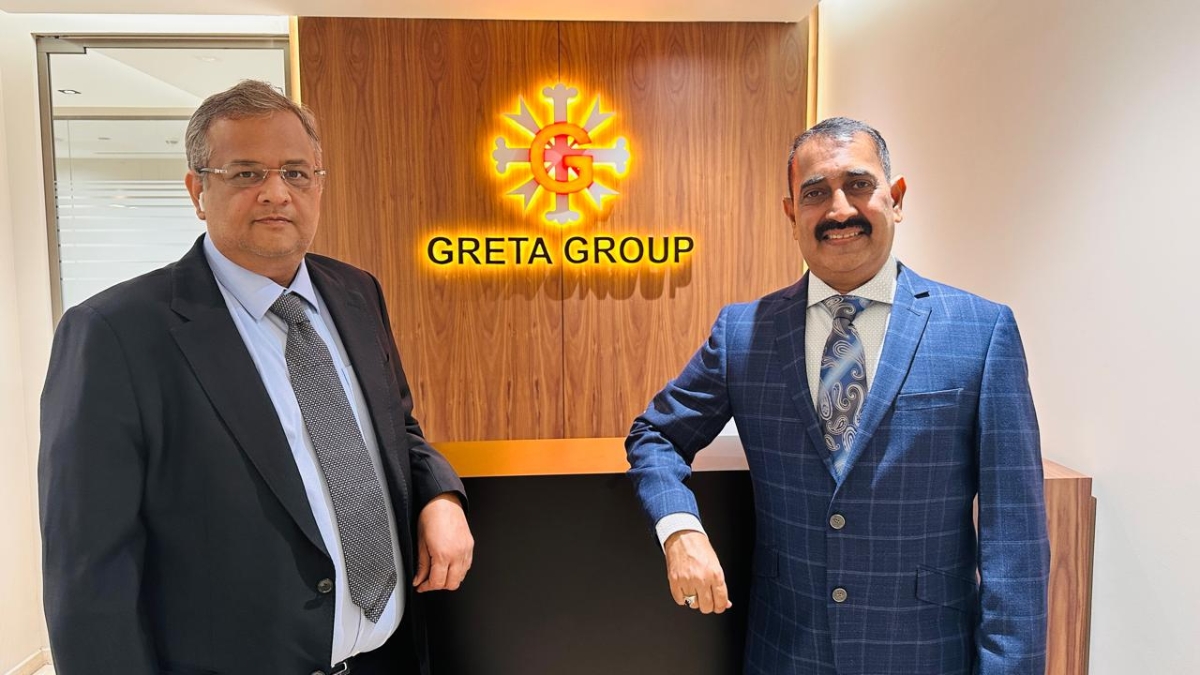
Nitesh Chaudhari, Chairman of Greta Group and Rajshekhar Kudupali, Managing Director, Greta Minerals
Singapore, October 10: Greta Minerals Pte Ltd, part of Singapore-based Greta Group, has doubled its exploration footprint in Western Australia to nearly 1,550 sq km, up from about 700 sq km acquired in 2024.
“We are very happy to expand our landholding, encouraged by the results of initial studies of Ultrafine+ soil sampling and analysis in one of our exploration areas, Gecko North. We believe we are in the right geological corridor to explore for lithium, gold, and other critical minerals,” said Nitesh Chaudhari, Chairman of Greta Group. The Gecko North Project, located 25 km northwest of Coolgardie, is one of seven critical mineral and gold projects under Greta Minerals (Australia) Pty Ltd. The company holds 37 granted and 5 pending mineral tenements, covering 1,550 sq km of prospective ground in Western Australia.
Gecko North lies within the Kalgoorlie Terrane of the Yilgarn Craton, east of the Ida Fault. This region is renowned for world-class deposits of gold and lithium. The ground also hosts the Silt Dam Monzogranite, part of the fertile Bali Suite monzogranites, which surveys link to both gold and lithium mineralisation.
Greta Minerals adopted the Ultrafine+ soil sampling & assay technique, developed by CSIRO and Labwest Minerals Analysis Pty Ltd, to detect deeper ore bodies. The method analyses ultrafine clay particles (<2 micrometres), offering higher sensitivity compared to traditional soil sampling.
Using this approach, 1,224 soil samples were collected across Gecko North, identifying:
- Three lithium anomalies, the largest stretching 6.4 km long, average 2.3 km wide, with lithium values peaking at 86.6 ppm Li.
- One caesium anomaly, up to 1.75 km long, 1.3 km wide, peaking at 41.7 ppm Cs.
- Three gold anomalies, including one within the Silt Dam Monzogranite, with peak values up to 50.5 ppb Au from a 900 m long, 400 m wide.
These findings point to a structurally complex but fertile system capable of hosting multiple mineral deposits. As India accelerates its push towards electric mobility and renewable energy storage, lithium demand is expected to soar. Currently, India imports nearly all of its lithium raw material requirements. Greta Minerals believes its projects in Western Australia—one of the world’s most stable and prolific lithium regions—can contribute to bridging this gap.
“Our exploration efforts are aligned with the growing global demand for critical minerals. For India in particular, securing a lithium supply will be key to powering EV adoption and grid-scale batteries. Greta Minerals, with its strong foothold in Western Australia, is well-positioned to be part of that supply chain,” said Rajshekhar Kudupali, Managing Director, Greta Minerals.
The company has also strengthened its team by appointing Derrick Kettelwell as Head of Exploration. It plans to expand its exploration programs and advance towards identifying viable deposits for future development.
With its doubled landholding, early geochemical successes, and focus on critical minerals, Greta Minerals is positioning itself not just as a resource developer in Australia but also as a potential partner in addressing India’s long-term lithium supply security.
Why Lithium Matters for India
India targets 30% electric vehicle adoption by 2030, requiring large-scale lithium-ion battery manufacturing. As per the announced capacities, India would have about 150 GWh Lithium-Ion manufacturing capacity.
Current Lithium & Cobalt associated imports by India is about $3.18 billion (FY2023).
Lithium is classified as a critical mineral under India’s new exploration and resource security framework.
- Energy Security: Lithium is central to renewable storage solutions, key for India’s solar and wind power integration.
- Global Race: Securing long-term lithium supply is vital as countries compete to lock in resources for clean energy transitions
About Greta Group
Greta Minerals PTE Ltd, part of the Greta Group, is headquartered in Singapore. Owned by NRI Mr Nitesh Chaudhari, Greta Group has built a notable presence in various industries, including trading (ferrous and non-ferrous metals), agriculture, mining, and power generation. Greta Minerals aims to explore and develop mineral resource assets, with a strong commitment to innovation, sustainability, and excellence. Greta Group is also setting up an integrated green steel plant in Maharashtra.
If you have any objection to this press release content, kindly contact [email protected] to notify us. We will respond and rectify the situation in the next 24 hours.
