



Nikhar Arora showed diamond and jewellery owners how AI agents can work across their trade, as orders return to the market
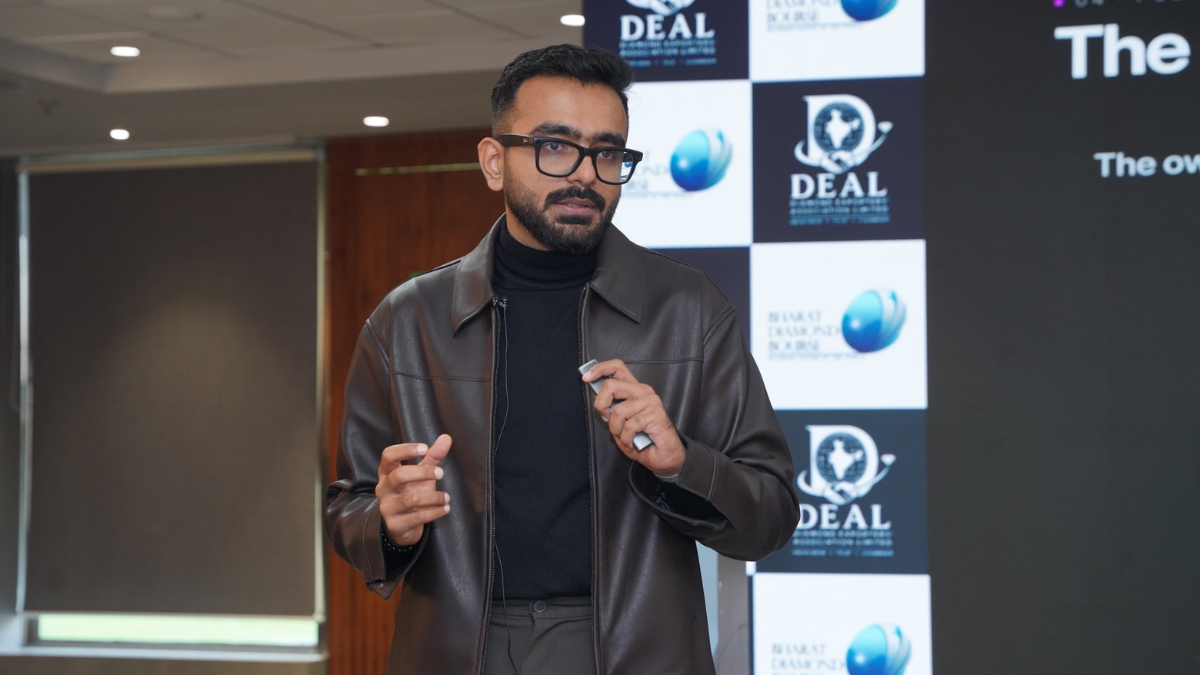
New Delhi [India], October 14: On 8 October, diamond and jewellery owners at Bharat Diamond Bourse (BDB) watched an AI agent plan a rough stone, another price a polished one, and a third turn a customer’s brief into a 3D render. The demonstrations were part of The Next Cut, a keynote by Nikhar Arora, Founder & CEO, Mentoria; Director, HR Anexi; and Head, BOTS.Ai by HR Anexi.
The timing matters. India’s exports of cut and polished diamonds fell 8.5% to $12.2 billion in FY26, according to GJEPC figures, and Surat’s units are working through a fresh backlog of orders. Arora’s case to the room was about meeting that demand without locking more cash into stock and receivables.
What was on stage
The agents that BOTS.Ai showed on stage followed a stone through the business, starting with the rough. The yield agent reads a scan of the stone, compares every possible cutting plan and picks the one that returns the most value. This is the step that decides how much of the rough is lost as wastage. Once the stone is polished, the pricing agent takes over. It reads the 4Cs, checks live market prices and recent sales, and gives the owner a price with the reasoning behind it.
Further down the line, a design agent matches a customer’s brief to the closest piece in the company’s own design bank and renders it in 3D. Hiring agents source and shortlist people for desk and factory roles alike, from merchandisers to karigars, at a time when units are looking to staff up again. In finance, an agent runs the vendor cycle end to end, from purchase through credit and debit notes, and reconciles invoices against payments.
One request on stage was spoken in Gujarati: a summary of the day’s Surat diamond market.
Arora was clear that the technology is meant to strengthen the trade, not hollow it out. “AI is not here to replace the karigar’s eye or the owner’s judgement,” he said. “It is here to give both more time for the work only people can do: relationships, negotiation and craft.”
Where the money sits
Arora gave owners one filter for any AI project. If it doesn’t raise revenue, cut cost, free up working capital, improve the customer’s experience or help beat a competitor, it shouldn’t be built.
In this trade, he said, working capital is usually where the biggest gains hide. In one diagnostic BOTS.Ai ran for a diamond and jewellery manufacturer, it identified ₹52 crore of annual value from AI. Close to half of that was cash tied up in inventory, receivables and slow procurement.
Humans and agents, one team
Arora’s larger point was about how companies will be structured. In an AI-native firm, he said, the org chart includes agents as well as people. Each agent has a defined job and a named person who owns its output. Roles get redrawn around that. People spend less time preparing work and more time checking it, deciding and building relationships. Hiring shifts too. Firms will need people who can brief and supervise agents, alongside the craftspeople and staff they already rely on.
“The next decade will measure growth in revenue per person,” Arora said. “Not because people matter less. Because each person can now do far more.”
The owners’ worries
Arora took the room’s concerns head-on. On data, he said the enterprise plans of the major AI providers generally don’t train on customer data by default, and that a bigger exposure for most firms is the free app on an employee’s phone. He asked owners to put a written AI policy in place. The advice lands as Indian businesses prepare for the Digital Personal Data Protection (DPDP) Rules, notified in November 2025, which set out how companies must handle the personal data they collect.
On mistakes, he said every agent BOTS.Ai deploys works maker-checker. The AI prepares the work and a named person approves it.
Product imagery got a sharper warning. Generative tools now turn one jewellery shoot into dozens of catalogue and campaign images, and the Advertising Standards Council of India’s new guidelines on AI-generated advertising, issued on 29 September and effective three months later, require advertisers to disclose AI content that materially shapes a buying decision. Misleading depictions of a product stay off limits with or without a label.
“A model will cheerfully add a prong, reshape a setting or brighten a stone, and each change is a promise to a customer about a product that does not exist,” Arora said. “Enhance the photograph, never the facts.” He added that someone has to own the final approval by name. “The most dangerous phrase in a company today is ‘the AI did it.’”
He ended with advice for the owners themselves. “AI doesn’t trickle up. It starts with the owner. If you don’t use it every day, nobody in your company will.” His suggestion was to run the existing business faster with AI while building a small, AI-native team beside it. “Don’t renovate the house you live in. Build the new one next door.”