


Mumbai (Maharashtra) [India], July 22: For a long time, India’s AI story felt pretty familiar—big market, but all the real technology came from somewhere else. Every chatbot, every voice assistant, every corporate AI tool ran on models made in labs in California or London. English always came first. Hindi, Tamil, Bengali, and the rest were barely an afterthought. Sarvam AI set out to change that, and honestly, by 2026, it’s become the clearest sign that India can build world-class AI for itself.
From Startup to The Face of Indian AI
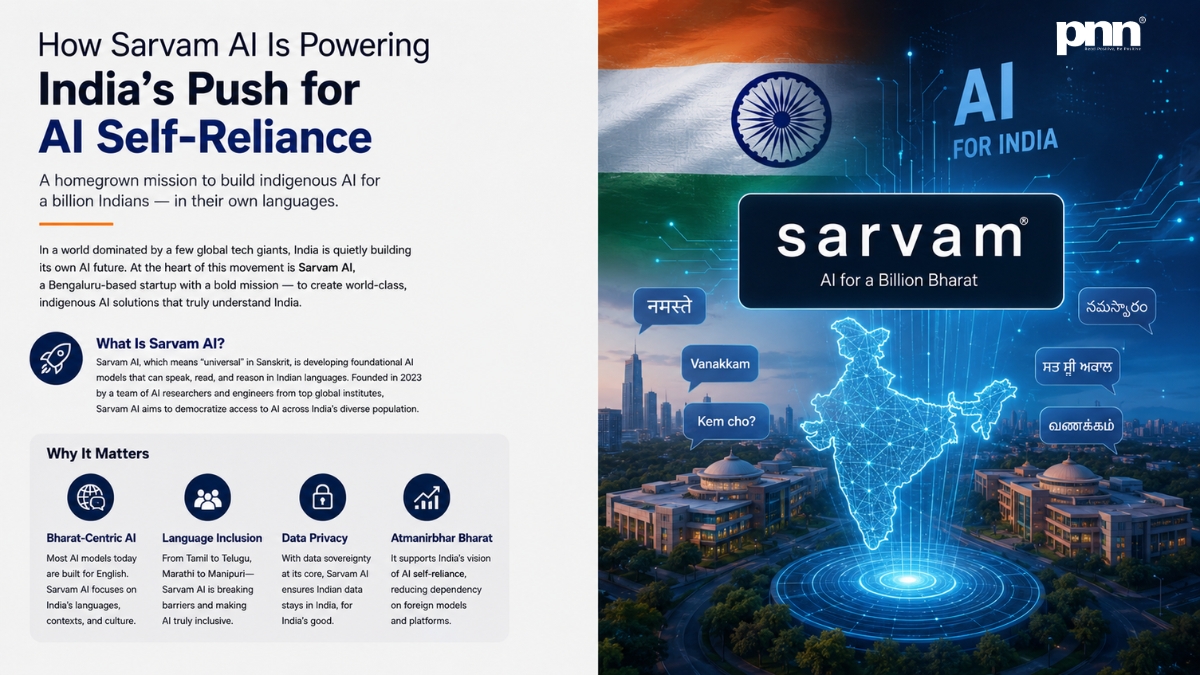
Sarvam kicked off in Bengaluru, back in 2023. Vivek Raghavan and Pratyush Kumar were the brains behind it—both engineers who’d worked on big national projects like AI4Bharat and Aadhaar. Their idea was simple: India didn’t just need access to AI, it deserved AI that actually “gets” India. That meant models built from the ground up for Indian languages, for how Indians speak, and for real Indian needs—instead of just sticking a translation layer on some foreign model.
Things really took off in April 2025. India’s Ministry of Electronics and IT picked Sarvam as one of twelve startups under the IndiaAI Mission to build indigenous foundational models. They gave Sarvam access to 4,086 Nvidia H100 GPUs for six months—the biggest allocation in the mission. For a small AI company, that kind of computing power is gold. It let Sarvam train its models right in India.
What Sarvam Built
In February 2026, at the India AI Impact Summit in New Delhi, Sarvam showed off what they’d built:
- Sarvam 30B — a 32-billion-parameter Mixture-of-Experts model made for speed and real-time chat. Think lightweight, up there with models from Google and OpenAI.
- Sarvam 105B — a 106-billion-parameter MoE model with a 128K context window meant for tough reasoning tasks and enterprise jobs.
The big deal wasn’t just how big these models are—it was that they’re all built, trained, and fine-tuned entirely in India. No foreign model weights lurking underneath. That matters, because critics always said “Indian AI” basically meant tweaking someone else’s work. Sarvam’s 2026 launch shut that down.
Both models speak 22 Indian languages and handle real-world stuff—voice agents, document processing, speech-to-text, translation, vision—all through accessible APIs for developers. They also rolled out Bulbul V3, a speedy voice-to-voice interface, and even got into hardware with Sarvam Kaze smart glasses, which support multiple Indian languages.
Not Just Demos—Actual Impact
Sarvam’s models aren’t just science fair projects; people are using them. Sales teams are closing deals in regional languages. Customer support is faster, since callers don’t have to swap to English to be understood. Sarvam’s really focused on Tier-2 and Tier-3 cities—farmers, students, small businesses. The kinds of people Silicon Valley never worried about, but who actually make up most of India.
In March 2026, Sarvam introduced a Startup Program—early-stage companies get API credits, engineering help, and infrastructure for up to a year to build multilingual AI. They don’t just want to be the model provider; they’re staking out a spot as the foundation layer for Indian startups, kind of like how AWS became the backbone of internet companies.
Investors Jump In
With results like this, money followed. In June 2026, Sarvam raised $300 million for its Series B, landing a $1.5 billion post-money valuation. HCLTech led the round, Bessemer joined in, and earlier investors like Khosla Ventures and Peak XV Partners stuck around. HCLTech isn’t just bringing cash—they’ve got relationships and the technical chops to help Sarvam actually deploy these tools inside big Indian companies.
The Real Challenges
Even with all this, India’s AI self-reliance isn’t finished. Sarvam’s models are trained at home, but they still rely on Nvidia chips—hardware India doesn’t make yet. The IndiaAI Mission has put about $1.25 billion behind sovereign infrastructure and added 20,000 GPUs to the national pool in 2026. That’s progress, but full control over AI is complicated—chips, compute, data, models, applications. Sarvam’s moved the needle on the model side. Infrastructure’s still catching up.
Why This Matters
Sarvam’s rise is part of a bigger global argument: AI shouldn’t just be another exported technology, built in a few countries and shipped everywhere else. Language, culture, and context matter. A farmer in rural Uttar Pradesh asking a voice assistant about crops needs something totally different from a lawyer in Manhattan drafting a contract. By putting Indian languages and needs front and center, Sarvam gave India something it just didn’t have before—a real, homegrown answer to what AI looks like when it’s built for a specific place.
Can Sarvam keep this momentum and compete with global giants? That’s still up in the air. But for now, Sarvam’s the most convincing example of what India’s AI push looks like for real—not just policy talk, but working models, actual deployments, and a $1.5 billion shot in the arm from investors who think it can go even further.