

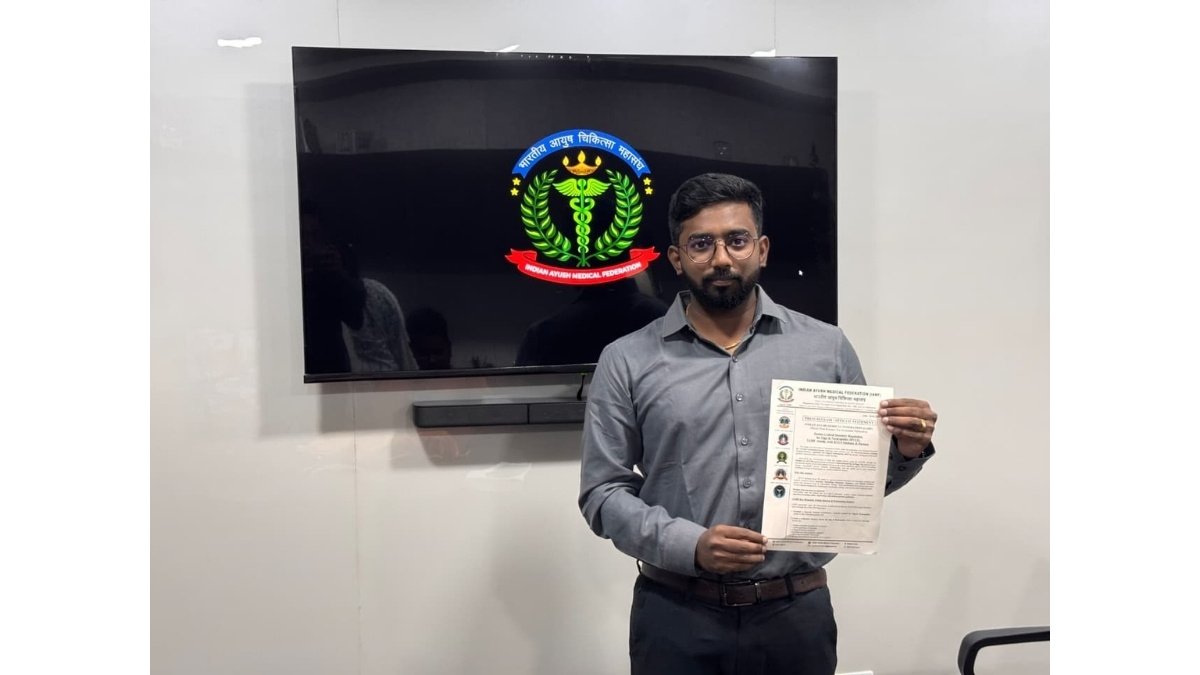
New Delhi [India], February 19: The Indian AYUSH Medical Federation (IAMF) has formally urged the Government of India to establish a Central statutory regulatory framework for Yoga & Naturopathy (BNYS), stating that the issue concerns academic justice, professional clarity, and public healthcare accountability.
The representation was issued by Dr. Aravind Lakshminarayanan, National President of the Indian AYUSH Medical Federation, following growing concern among BNYS students and practitioners across multiple states regarding the absence of a dedicated national regulatory authority for the discipline.
A Visible Regulatory Gap
In 2020, India restructured AYUSH governance through the establishment of:
● The National Commission for Indian System of Medicine (NCISM) governing Ayurveda, Siddha, Unani and Sowa-Rigpa
● The National Commission for Homoeopathy (NCH)
However, Yoga & Naturopathy were not included under an equivalent statutory commission.
While certification and institutional mechanisms currently exist, there is no comprehensive central statutory authority regulating Yoga & Naturopathy education, registration, and professional standards uniformly across India.
According to IAMF, this has resulted in administrative inconsistency and varying recognition across states.
Drugless Does Not Mean Unregulated
BNYS is a 5½-year medical education program including internship and clinical exposure. The curriculum includes: Anatomy, Physiology, Pathology, Diagnosis, Clinical training, Preventive and lifestyle medicine, Yogic therapy and naturopathy modalities
“These professionals are trained to address preventive healthcare, rehabilitation, and lifestyle disorders — areas of increasing national importance,” said Dr. Aravind Lakshminarayanan.
He further stated:
“Drugless therapy does not mean regulation-less therapy. Any healthcare discipline dealing with human health must function within a clear legal and professional framework.”
Student Concerns Emerging Nationwide
Discussions among students and practitioners across several states indicate increasing concern regarding:
● Lack of uniform central registration
● Differences in recognition between states
● Professional identity ambiguity
● Long-term career clarity
IAMF clarified that the issue is not a conflict between medical systems but a structural regulatory gap.
“This is not a comparison with any other medical system. The request is simply for clarity within Yoga & Naturopathy itself,” the federation noted.
IAMF Recommendations to Government of India
The Federation has proposed two policy pathways:
1. Establish a Separate National Commission / Central Council for Yoga & Naturopathy
OR
2. Create a statutory Board under a Central Act empowered to regulate:
○ Education standards
○ Curriculum uniformity
○ Central practitioner registration
○ Institutional recognition
○ Ethical and disciplinary mechanisms
○ National professional identity
Public Health Significance
IAMF emphasised that Yoga & Naturopathy play a major role in:
● Preventive healthcare
● Lifestyle disease management
● Non-communicable disease control
● Integrative healthcare models
“With lifestyle disorders rising rapidly, strengthening preventive healthcare capacity is a national priority,” the federation stated.
A Constructive Representation
IAMF clarified that the appeal is constructive and solution-oriented.
“India has taken historic steps to promote AYUSH globally. This representation seeks completion of that vision through statutory clarity for Yoga & Naturopathy,” said Dr. Aravind Lakshminarayanan.
National Implications
The federation cautioned that absence of regulatory clarity may lead to:
● Reduced student admissions
● Public confusion regarding professional status
● Administrative inconsistencies
● Underutilisation of preventive healthcare workforce
Conclusion
The Indian AYUSH Medical Federation reiterated that its request is based on:
● Academic justice
● Professional dignity
● Patient safety
● Regulatory clarity
● Strengthening preventive healthcare
“Recognition brings responsibility. Regulation protects the public,” the statement concluded.
Issued by:
Indian AYUSH Medical Federation (IAMF)
National President
If you object to the content of this press release, please notify us at [email protected]. We will respond and rectify the situation within 24 hours.