



Mumbai (Maharashtra) [India], January 17: Read a few writings of Kafka and you will notice something under your shoes; and this ground that you are standing upon, it would seem to collapse into an abyss of absurdist thoughts, thoughts that seek purpose, thoughts that would make you crawl under the bed and force you to die, a strange sense of metamorphosis, the one that woke Buddha up into a night and convinced him to leave his home and wife and children behind.
When you discover something different from the sense of reality of other people; you are most prone to die, see for example, Galileo had to die for a discovery that the world did not buy into, Gregor Samsa of Kafka’s novel Metamorphosis too had to die because he discovered something strange in life, the realization of the absurdity of life, the utter sense of meaninglessness; the lie of life’s beauty shattered into pieces that one cannot collect.
Since the emergence of human civilization, people had stories to tell and philosophers had doubts to be solved. The favorite question was ‘who’s the creator of us all?’ and this gave rise to the ideas of religion, the craft of storytelling flourished and the masses turned into a herd of believers, but the doubters were doubters still. For a story to survive, there should always be a believer. For the first quarter of 20th century, we enjoyed stories of human origin, the stories of Adam and Eve and all, but after the two world wars, the human psyche got another prominent question, “the purpose of human life” and the utter meaninglessness of it. The present realities were troublesome and people found solace into the memories of past, memories of cities that were now standing upon the debris of restlessness, memories of people who were turned into vapors by atomic bombs.
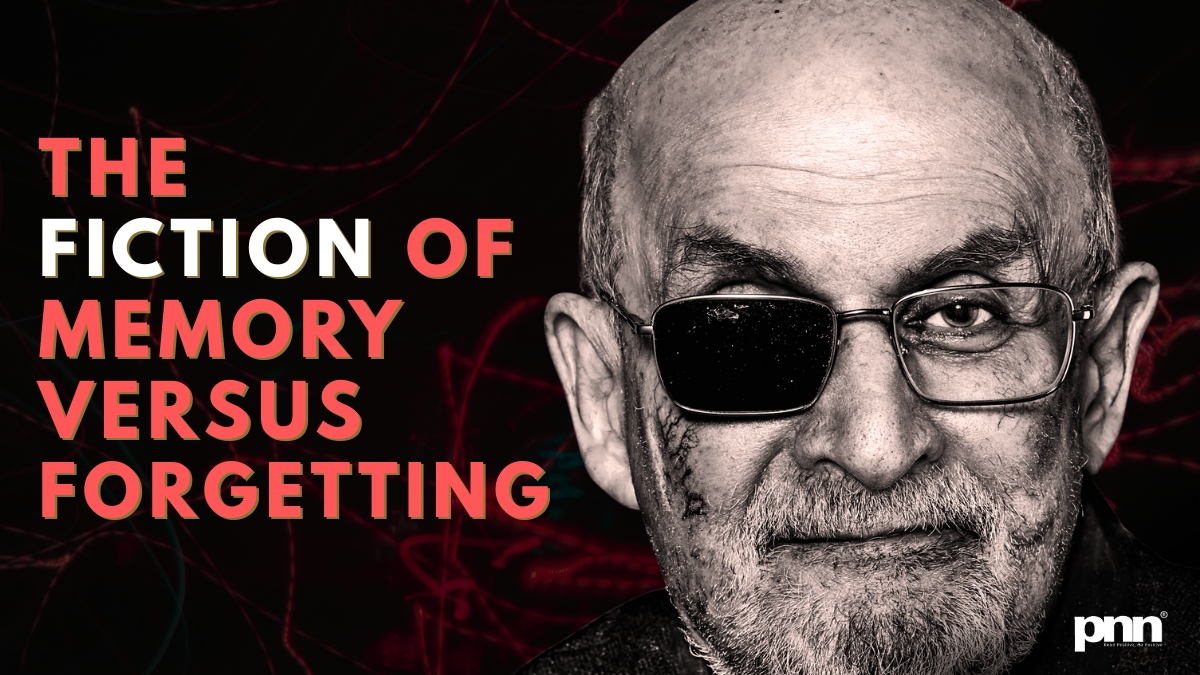
The fiction of memories is also the fiction of forgetting; memories make us forget our present life scenarios but can we ever forget our memories at all? What are memories made up of; and are they capable of preserving our reality? Now one might ask, what is this reality we are talking about? As the holy audience of Christopher Nolan, we might get into the debate of whether the reality we perceive is real or it’s a mere dream; and are we capable enough to perceive it at all? Yes, you got it right, the petty debate of forth dimension. I’m no Dostoevsky, I would no more talk sickness, let’s get onto the point. Let’s talk about two things, precisely. One is the fiction based upon memories, and the other one is the idea of forgetting. Both are quintessential to understand our clumsy quotidian life. I’m aware of the absurd nature of my petty trail of thoughts, and therefore I would limit this discussion to a single author and a single book of him, I would avoid the Jacques Derrida way of meaning of the meaning of the meaning here; now let’s start with an esteemed author of Indian Diaspora, he is none other than Salman Rushdie.
In his essay collection ‘Imaginary Homelands’, Salman Rushdie makes a confession that the Bombay of his ‘Midnight’s Children’ is not the actual city of present-day reality, but it was the Bombay of his memories. When Rushdie wrote about Bombay while sitting in London, he just looked at his window at times and recalled the city as it was in his mind; the city where Rushdie grew up, the city of memories and imagination. The fiction came out of it was real, but somewhere lost in translation. However, the beauty of translation is that we gain something too. It happens with most of the Diasporic writers and expatriate writers that they have to write about their native lands relying upon their memories and imagination. Sometimes, to remember the past and at other times to forget their present agonies and sorrows. Sometimes, to get a sense of belonging, and at times to forget the foreign belongings that they had adapted in order to survive. When people are fed up of the absurdities of life, they would either wait for Godot or recall the toothpastes and chutneys of their memories. Forgetting requires transporting of Coleridge’s type, but when we are back to the routine, do we really forget anything? As the humans of post lapsarian era, are we really capable of forgetting? Do we forget or do we get distracted? The literature written around memory and forgetting would make you question your realities. In the end you will realize that memory is nothing but a euphemism used for forgetting.
If you object to the content of this press release, please notify us at [email protected]. We will respond and rectify the situation within 24 hours.