



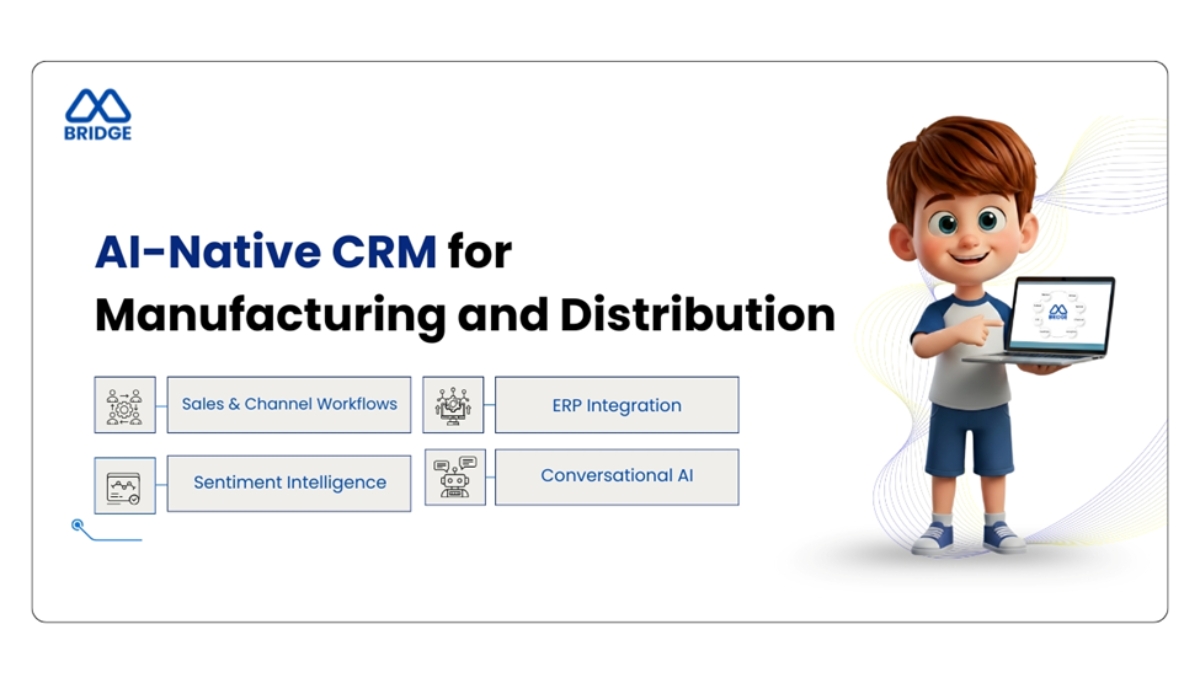
New Delhi [India], January 6: Bridge CRM is an AI-native customer relationship management system made for companies focused on manufacturing and distribution. The platform introduces Milo, an AI-powered conversational assistant aimed at supporting sales, dealer, and service operations across complex business ecosystems.
Bridge CRM is built to support interactions among OEMs, dealers, distributors, and key accounts by combining conversational AI with industry-specific workflows. According to the brand, the intelligence-intuitive platform, with its eight suite applications, is designed to understand industry-specific context, buyer intent, and customer sentiment, enabling it to surface insights and automate actions across processes such as lead-to-order cycles, RFQs, dealer engagement, service requests, and post-sales follow-ups.
The system uses natural language processing to allow users to interact with CRM data conversationally, while also generating summaries, alerts, and workflow recommendations in real time. This approach is intended to reduce manual follow-ups, improve pipeline visibility, and help sales teams respond more quickly to customer needs.
Introducing Conversational Intelligence with Milo: Your AI Teammate
At the centre of the platform is Milo, described as an AI co-pilot that monitors business activity, summarises customer conversations, and highlights contextually relevant insights. Milo can assist with tasks ranging from identifying sales opportunities to generating performance summaries, Just Like An AI Teammate.
For example, Sales managers can request regional performance insights, such as identifying top sales performers, and receive summarised outputs instantly.
Not only on the data basics, but Milo can help just like a guide to execute tasks like,
“Milo, help me plan the inventory for the Manesar region and plan the next batch accordingly, with a reminder on a margin of 25%”
“Milo, create my beat plan for today in the North Zone based on priority dealers and pending follow-ups.”
“Milo, list high-value opportunities in my region that are most likely to close this week.”
“Milo, show me overdue follow-ups for my key accounts that need action today.”
“Milo, give me a summary of my sales pipeline and expected revenue for this month.”
“Milo, identify underperforming territories and suggest actions to improve sales.”
Bridge CRM is designed with integration as a core capability. The platform connects with ERP systems and is recognised by top shots like SAP Business One and Oracle NetSuite to synchronise data across applications, aiming to provide a unified view of customer and operational information while minimising manual data entry. According to the company, this integration helps maintain continuity when team members change roles, as customer history and interaction summaries remain accessible within the system. With the ERP sync, RFQ is logged in CRM, converted into an opportunity, and a quotation is generated using ERP-synced pricing and approvals.
Workflow-Centric Design for Manufacturing and Distribution
Bridge CRM structures end-to-end business processes into defined workflows to support coordination between OEMs, dealers, distributors, and field teams. These workflows include:
- Exhibition to Lead: Capture and manage exhibition and campaign leads within a centralised customer and lead master.
- Lead to Order: Convert qualified leads into sales orders with visibility across pricing and approvals.
- Dealer & Distributors Onboarding: Manage dealer pricing structures, credit limits, and engagement for clarity on the process.
- Order Fulfilment & Dispatch: Monitor inventory availability, dispatch status, and delivery timelines.
- Field Operations: Enable field teams with access to order status, stock information, and customer data. Through Bridge FieldOps, the dealer checks live inventory, credit balance, applicable schemes, and order history. Orders are placed directly into the system and synced with ERP for fulfilment.
- Service and Warranty: Track service requests, warranty claims, service costs, and spare usage.
- Insights: Generate operational and performance insights across functions. Give me today’s order status, top-performing dealers, and delayed dispatches.”
- Bridge combines data from sales, dealers, and ERP to deliver a summarised insight instantly.
Why Choose Bridge CRM & Milo?
- Make every customer interaction smarter and more productive.
- Automate routine tasks to save time.
- Around 30% reduction in manual follow-ups through AI-based task automation.
- 20–26% extensive pipeline visibility with real-time insights.
- Faster decision-making through conversational access to CRM and ERP data.
“Bridge and Milo represent a shift toward CRM systems that actively participate in business operations rather than simply storing records,” said the CEO of Bridge. “The focus is on enabling teams to work with greater clarity and efficiency by having AI embedded directly into their daily workflows.”
The platform includes features such as conversational AI, automated task management, predictive analytics, and real-time sentiment analysis. Bridge states that these capabilities are intended to support more personalised customer engagement and proactive decision-making across sales and service teams.
Bridge CRM with Milo AI autopilot is available for enterprise customers. More information is available at www.bridgesuite.ai or via email at [email protected]
If you have any objection to this press release content, kindly contact [email protected] to notify us. We will respond and rectify the situation in the next 24 hours.