



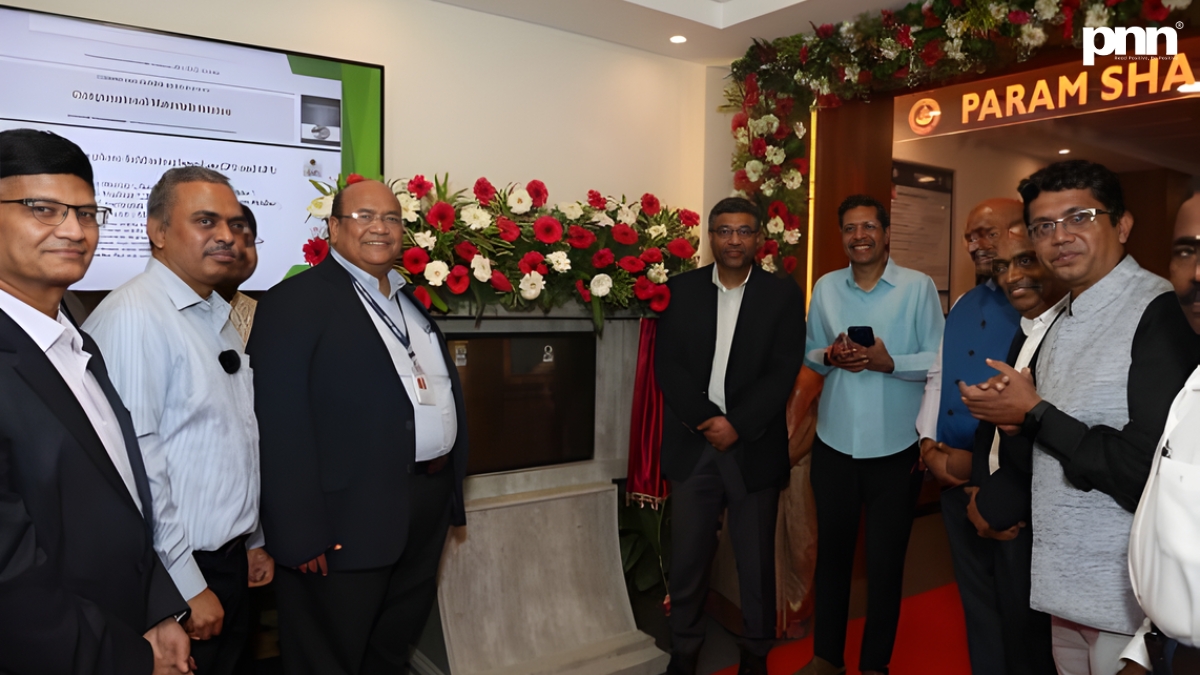
New Delhi [India], January 10: When S Krishnan, the Secretary of the Ministry of Electronics and Information Technology (MeitY), recently inaugurated PARAM SHAKTI at IIT Madras, it was not the customary ribbon-cutting ceremony but a bold statement of India becoming more technologically empowered. PARAM SHAKTI is not just another supercomputer. It is built on homegrown hardware, based on C-DAC RUDRA servers, and operates on an indigenous software stack using the open-source AlmaLinux. It can perform 3.1 quadrillion calculations per second—yes, quadrillion, with a capital Q.
It is not a flashy technological flaunt. It is an Indian science turbocharger. Researchers in aerospace, materials science, climate modeling, drug discovery, and advanced manufacturing now have a device that compresses decades of experiments into months, sometimes even weeks. Slow science? That’s officially a thing of the past. PARAM SHAKTI has put Indian research on the fast track, and the finish line is nowhere in sight.
At Work: Building a National Supercomputing Mission
PARAM SHAKTI is part of the flagship National Supercomputing Mission (NSM), led by MeitY and the Department of Science and Technology. The mission has already deployed 37 supercomputers across major Indian research institutions, with more under construction—including a massive facility planned in Bengaluru. India is not playing small; it is building a network of computational power capable of competing on a global scale.
Krishnan highlighted the mission’s philosophy: differentiated, scale-oriented, and sovereign technology. It is not just about speed—it’s about independence. India is reducing dependency on single GPU vendors and foreign hardware or software stacks. The vision is clear: a robust AI and computational ecosystem capable of supporting India’s ambitious scientific and industrial plans.
IIT Madras: Where Machines Meet Magic
For IIT Madras, PARAM SHAKTI is more than a showcase. Operational since May 2025 and running at over 80% utilization, it supports research ranging from sub-atomic electronics to large-scale structural and climate simulations. With a power usage effectiveness (PUE) between 1.2 and 1.4, the supercomputer is energy-efficient while delivering high performance. Even supercomputers cannot ignore the electricity bill.
Prof. V. Kamakoti, Director of IIT Madras, urged students and researchers to create energy-efficient, shareable, and robust programs, building on a legacy that started with the National Knowledge Network. E. Magesh of C-DAC also praised the rigorous engineering of the RUDRA servers, India’s homegrown answer to global HPC technology, proving that world-class performance does not require foreign reliance.
Powering AI, Innovation, and India
PARAM SHAKTI is not just a number-crunching powerhouse—it is India’s future-proofing strategy for research and innovation. Through the IndiaAI Mission, the supercomputer allows researchers to experiment freely, innovate boldly, and avoid tech monocultures. No foreign restrictions, no dependency graphs—raw computational power is fully in the hands of Indian scientists.
The potential is enormous. Expect breakthroughs in drug design, climate prediction, aerospace innovation, and advanced manufacturing. This machine is the rocket enabling Indian scientists to operate at a speed and scale comparable to the world’s top labs. The message is simple: India can compete, and today it can compute faster, smarter, and bigger than ever before.
PARAM SHAKTI is more than a supercomputer. It is an icon of India’s self-reliance, ambition, and technological boldness, placing the nation firmly on the global map for high-performance computing and next-generation scientific breakthroughs.
Boosting India’s Global Research Standing
With PARAM SHAKTI, India is no longer just a participant in the global research race—it’s becoming a leader. By providing world-class computational power domestically, the country reduces reliance on foreign supercomputing resources and strengthens its scientific sovereignty. Researchers can now tackle complex problems in AI, climate science, and advanced manufacturing at speeds that rival international labs, giving India a competitive edge in innovation and technological breakthroughs. This investment signals to the world that India is serious about being at the forefront of high-performance computing and global scientific discovery.
PARAM SHAKTI
https://www.youtube.com/watch?v=9AtBzbllQ50