



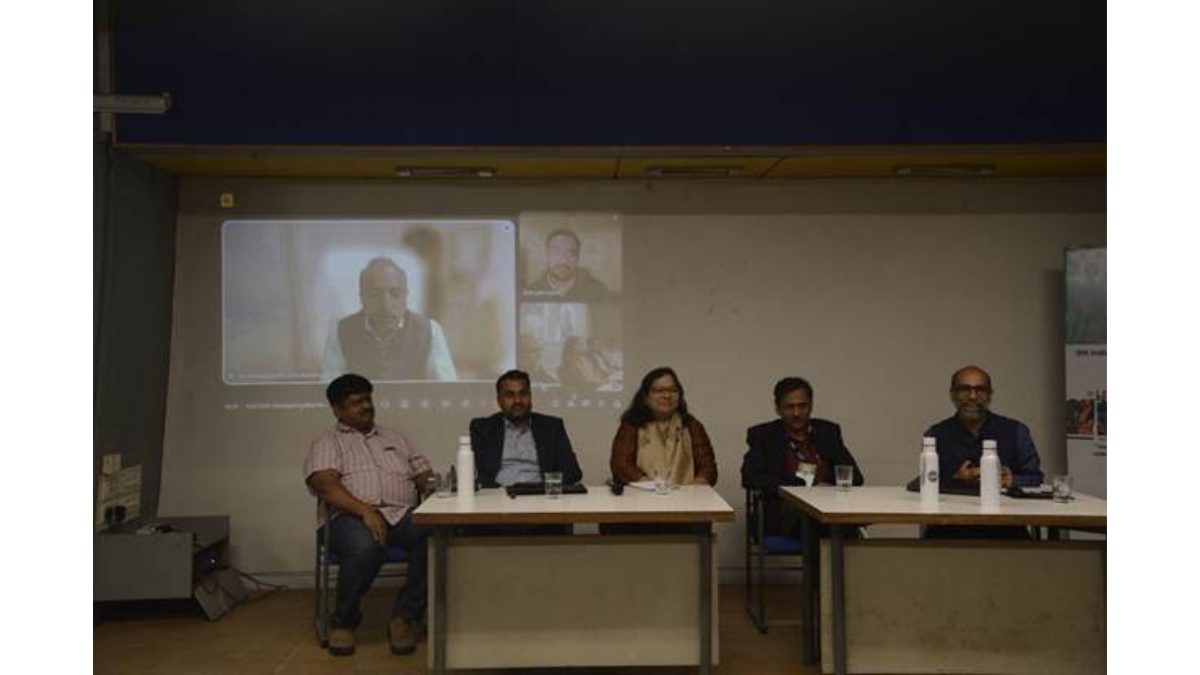
On screen (clockwise): Kunal Satyarthi (IFS, Joint Secretary, MoRD), Aniruddh Sheth (CEP), From (L-R): Subrata Singh (FES), Manish Parmar (ISRO-SAC), Archana Chatterjee (IUCN/FLR), Purnendu Kavoori (CSE), Dr. Abi T. Vanak, Director, CPD-ATREE
Expert consensus (Union Ministry of Rural Development, Centre for Pastoralism, Foundation for Ecological Security, ISRO-Space Applications Centre, IUCN/Forest Landscape Restoration, Centre for Social Ecology, and ATREE-CPD): Colonial-era “wasteland” categorisation threatens biodiversity, pastoral livelihoods, and India’s global climate commitments
New Delhi [India], November 21: A high-level panel convened by the WestBridge-supported Centre for Policy Design (CPD) at the Ashoka Trust for Research in Ecology and the Environment (ATREE), called for an urgent reclassification of India’s wastelands, stating that properly classifying and managing grasslands, wetlands, pastures, and commons, including Orans, Gochar lands, could unlock significant ecological and economic value.
The panel was a part of the 9th India Land Development Conference (ILDC) that brought together leading policymakers, researchers, practitioners, and civil society leaders for an evidence-driven dialogue on land governance and ecological transition. The session, titled “Reimagining ‘Wastelands’ of India: Policy Discussions for Arid Commons,” featured prominent voices including Kunal Satyarthi (IFS, Joint Secretary, Ministry of Rural Development, GoI), Manish Parmar (ISRO-Space Applications Centre), Aniruddh Sheth (Centre for Pastoralism), Subrat Singh (Foundation for Ecological Security), Archana Chatterjee (IUCN/Forest Landscape Restoration), and Dr. Purnendu Kavoori (Centre for Social Ecology). The panel set out to understand how grasslands, pastures, wetlands, grazing lands, and village commons, open natural ecosystems that sustain livelihoods and biodiversity, can be mapped, reclassified and re-evaluated under India’s land administration framework.
Speaking about the environmental and economic importance of these ecosystems, panel moderator, Dr. Abi T. Vanak, Director, Centre for Policy Design, ATREE said, “The term ‘wastelands’ is a misnomer. It implies that land so designated is unutilised and hence is meant to be developed or turned into plantations. Actually, many such land parcels, including grasslands, savannahs, semi-arid lands, deserts, and wetlands, are biodiversity hotspots that sequester carbon dioxide and are critical to rural economies. Village commons that provide services worth INR 5-7 lakh crore per year, need to be properly recorded and managed. Instead of looking at them as free-for-construction/tree plantation sites, their potential to drive rural economies and accommodate the mobility and dynamic adaptations of pastoral communities”
While reserved forests, sanctuaries, and national parks have clear ownership, management plans, and protection mechanisms, ‘wastelands’ have ambiguous tenure and ownership remains contested. Less than 5% of Open Natural Ecosystems (ONEs) fall under India’s Protected Areas Network, and about 70% of ONEs fall under the wasteland classification.
Speakers highlighted that this outdated classification has far-reaching consequences. Ambiguous tenure allows commons to be diverted for infrastructure projects under the guise of “unused land,” while productive grasslands are frequently planted over through compensatory afforestation due to flawed categorisation.
Kunal Satyarthi, IFS, Joint Secretary, Ministry of Rural Development, Government of India, commented on the need for better management of open natural ecosystems and village commons. He explained that since commons fall between departments, categories, and data systems, they are often overlooked in policy matters. He stressed the need for an integrated governance approach that would treat these landscapes as part of a living, interdependent system. In addition, recognising mobility, seasonality, and shared use as legitimate forms of land management would enable smarter, fairer, and more future-ready decisions.
The panel presented a set of concrete proposals. A harmonised national mapping portal integrating satellite data, pastoralist movement patterns, and seasonal land-use was deemed essential for accurate classification. Pastoralist mapping efforts underway in several states demonstrate that these landscapes generate economic value of up to ₹1.3 lakh crore annually—evidence that grassroots-dependent lands are anything but “waste.”
International frameworks were cited as powerful levers for change. India’s Land Degradation Neutrality commitments, its pledges under the Bonn Challenge and Convention on Biological Diversity’s 30×30 target, and its climate NDCs can all be advanced more effectively by protecting, restoring, and correctly classifying commons. Recognising these landscapes as OECMs (Other Effective area-based Conservation Measures) and capturing their ecosystem services, valued at US$90–110 billion annually, would strengthen both ecological and development outcomes.
The discussion concluded with a shared call to action: India must create a unified, publicly accessible National Atlas covering all types of land use, integrating accurate tenure, use, and seasonal data for grasslands, wetlands, pastures, and other commons, providing a single source of truth to guide infrastructure siting, inform afforestation planning, and prevent illegal diversion.
India is losing irreplaceable landscapes to systemic misclassification, and unless this is corrected at both the revenue and policy levels, the country will continue to see its most biodiverse, livelihood-critical ecosystems replaced by unsuitable development patterns and ineffective afforestation efforts.
If you object to the content of this press release, please notify us at [email protected]. We will respond and rectify the situation within 24 hours.