



Surat (Gujarat) [India], August 6: While the holy thread of Raksha Bandhan binds brothers and sisters in a relation of care and love, another thread—entwined in the literature of Devavani (the language of the gods)—silently makes the cultural DNA of Bharat stronger. World Sanskrit Day, which comes every year on Shravan Purnima, is not merely an ode to a classical language—it’s a clarion call to bring back a civilisation’s soul.
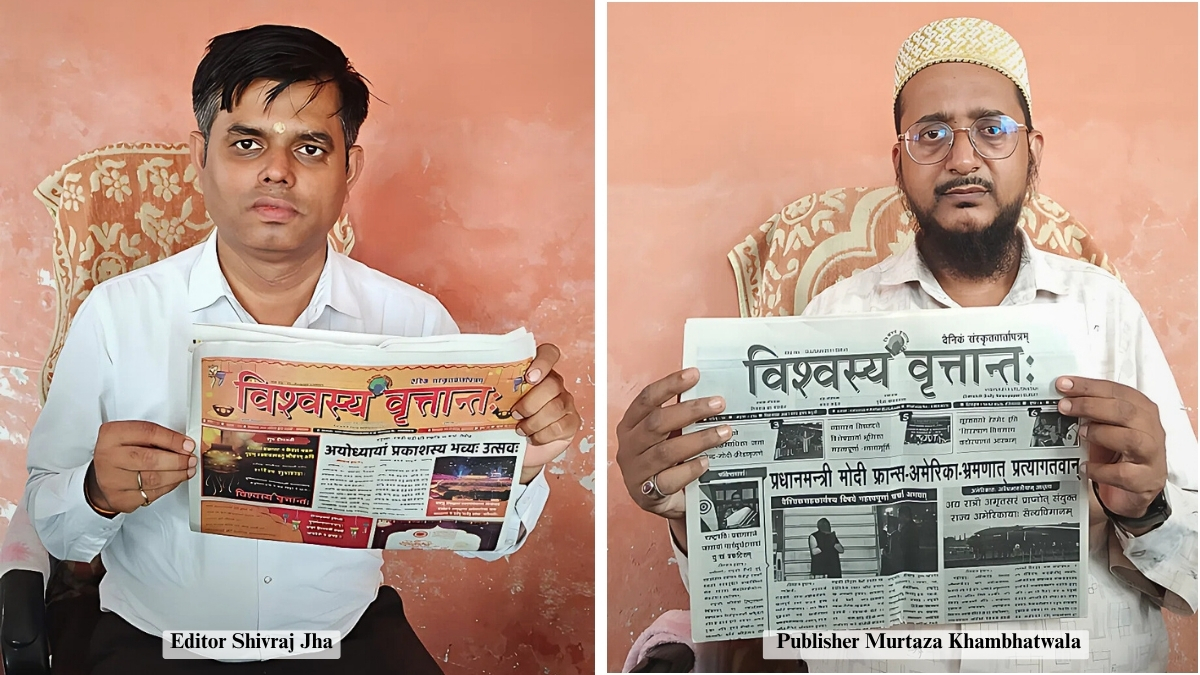
For more than 15 years now, ‘Vishvasya Vrutantam’, a Sanskrit newspaper based out of Surat, Gujarat, has remained a testament to that behest. At a time when online chatter swamps cultural complexity, this newspaper has elected against-the-grain articulation—in Sanskrit.
Sanskrit: More Than a Sacred Script
To many, Sanskrit is a language locked in the sanctum of temples, fit for chants and rituals alone. But ask Shri Shivraj Jha “Shantey”, the articulate editor of Vishvasya Vrutantam, and he’ll dismantle that perception with clarity:
“Sanskrit isn’t just ritualistic. It’s scientific. It’s poetic. It’s philosophical. It’s precise. And above all, it’s alive—if we let it live.”
The paper doesn’t just report in Sanskrit. It speaks to today’s reader—whether it’s politics, science, sports, or social movements, Vishvasya Vrutantam presents it all in accessible, journalistic Sanskrit. That’s not merely reportage; that’s a revolution in disguise.
From Surat to the World: The Quiet Expansion
What began as a local initiative has grown into a global cultural bridge. With readers not just in India but also in Ireland, the US, and other parts of Europe, the publication has carved a niche in unexpected places.
Ireland, for instance, has introduced Sanskrit in some of its primary schools—something India might do well to emulate more ambitiously. The irony is not lost: as the West rediscovers Indic wisdom systems, Indians often regard Sanskrit as “too difficult” or “outdated.”
A Publisher’s Mission
At the heart of this unique media venture is Murtaza Khambhatwala, the publisher who believed that Sanskrit deserved its place on breakfast tables, just like English or Hindi. For him, the decision was simple:
“If we can publish dailies in dozens of Indian languages, why should Sanskrit remain sidelined—the very mother of them all?”
Khambhatwala’s vision isn’t fuelled by nostalgia; it’s a strategy to make Sanskrit visible, usable, and modern. The publication circulates digitally to hundreds of readers, offers simplified sentence structures, and makes room for contemporary content—all while upholding linguistic purity.
The State’s Acknowledgment
In 2019, the Gujarat edition of the Sanskrit Bharati convention witnessed the Vishvasya Vrutantam team being honored by the Chief Minister himself. It was not just a token gesture—it was an institutional recognition of a movement that was grassroots in nature.
The journal has documented more than 600 key events in Sanskrit such as cultural events like the Prayagraj Mahakumbh, government schemes, and educational reforms in Uttar Pradesh. Symbolically, these articles were handed over in the form of a book to CM Yogi Adityanath, further strengthening the position of Sanskrit not merely in tradition but also in governance and communication.
Not Just for Classrooms—For Conversations
With the New Education Policy (NEP) giving Sanskrit a renewed place in school curricula, the need for day-to-day content in the language is now greater than ever. Textbooks alone won’t breathe life into Sanskrit—it needs conversational, contemporary use, which this newspaper supplies with consistency.
What Vishvasya Vrutantam is doing is something few institutions have managed: normalising Sanskrit. Not just for ceremonies or slogans, but for analysis, interviews, editorials, and even advertisements.
The Everyday Test: Will We Use It or Just Praise It?
If Sanskrit is to reassert itself as the foundation of Indian intellectual life, it needs to become a contemporary language, not a retro one. That implies pulling it out of upper-class seminars and putting it into WhatsApp groups, newspaper columns, YouTube interviews, and podcasts.
And that’s precisely what Vishvasya Vrutantam is planning. With new audio editions, mobile-friendly editions, and content for learners of Sanskrit, this is not a book—it’s a movement of the people, a people’s language movement.
The Script of a Civilization, Still Being Written
On this World Sanskrit Day, while India balances between fast modernisation and rediscovery of culture, the need for Sanskrit is no longer a point of argument. It is the tongue of Ayurveda, of Yoga Sutras of Patanjali, of mathematics of Bhaskaracharya, of drama of Kalidasa, and of a thousand-year-old civilizational dialogue.
Sanskrit is not merely a language, it is the operating system of Indic wisdom.
And in Surat, a small but mighty team of journalists is making sure that operating system stays updated—daily.
And So, the Pen Returns to Sanskrit
To forget Sanskrit is to forget the DNA of Bharat. But to revive it, we don’t need revolutions. We need routines.
Newspapers such as Vishvasya Vrutantam are demonstrating that Sanskrit journalism is no novelty—it is a need.
This World Sanskrit Day, let the word resound in every Indian household: संस्कृतं जीवति — Sanskrit Lives.